Written by
Abbie Mason
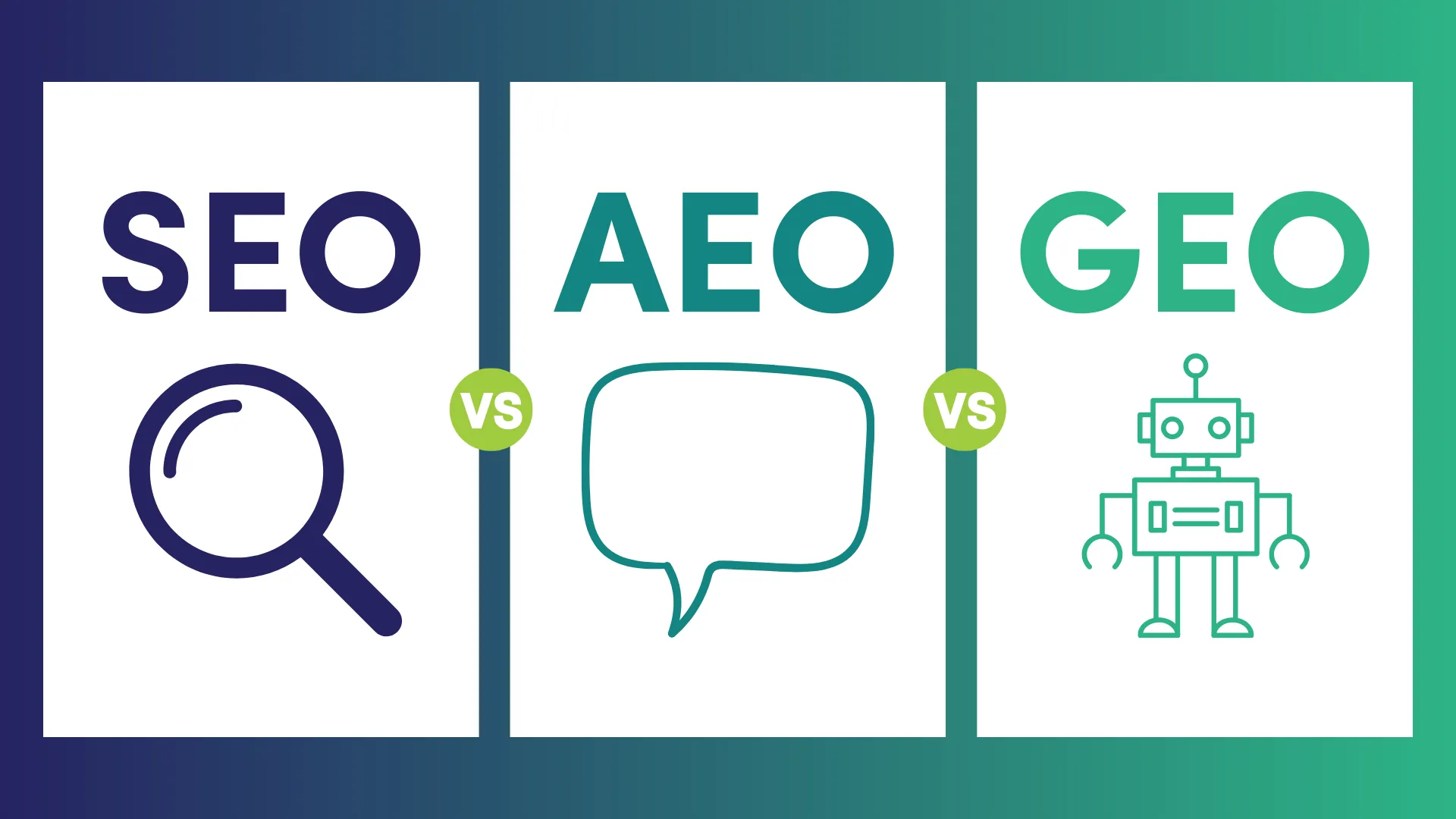
SEO vs AEO vs GEO
Three acronyms. Plenty of crossover. An impressive amount of marketing jargon.
Introduction
Search has changed. Again.
For years, getting found online largely meant one thing. Showing up on Google when somebody searched for something relevant to your business.
That gave us SEO, or search engine optimisation. Then search results started answering more questions directly and AEO entered the conversation. Now platforms including ChatGPT, Google AI Mode, Gemini and Perplexity are generating complete answers of their own, which has brought GEO into the mix.
Three acronyms. Plenty of crossover. An impressive amount of marketing jargon.
But there is a genuine shift happening underneath all of it.
People are no longer always searching, clicking and browsing in that order. Sometimes they ask a question and get the information they need without visiting a website at all. Sometimes an AI platform researches several sources on their behalf. Sometimes Google itself produces the answer before the traditional results have even started.
So where do SEO, AEO and GEO fit into all of that?
First, SEO
SEO stands for search engine optimisation.
At its simplest, SEO is the work involved in helping search engines understand your website and increasing the likelihood that the right pages appear when somebody searches for something relevant.
Google describes SEO as helping search engines understand content while helping users find a site and decide whether they should visit it. Google Search Central’s SEO Starter Guide
Traditional SEO covers things such as
Understanding what your audience searches for
Creating genuinely useful content around those topics
Making sure pages can be crawled and indexed
Improving website structure and internal linking
Earning relevant external links and authority
Optimising page titles, headings and on-page content
Making websites fast, usable and accessible
Using structured data where it genuinely helps search engines understand a page
None of that has suddenly become irrelevant because AI has arrived.
In fact, Google has been fairly explicit about this. Its current guidance says the fundamentals of SEO are still the foundation for appearing in AI Overviews and AI Mode. Google’s guidance on optimising for generative AI search
That matters because there is already a growing industry selling the idea that everything we knew about search has been ripped up overnight.
It hasn’t.
The environment around search has changed, but good websites still need to be discoverable, understandable, useful and trustworthy.
Then there is AEO
AEO stands for answer engine optimisation.
The emphasis shifts slightly here.
SEO traditionally asks how we can get a page to rank for a search.
AEO asks how we can make our information useful enough to become part of the answer itself.
That could mean appearing within a featured result, being surfaced by an AI-powered search experience, or having your brand included when a platform such as ChatGPT responds to a relevant question.
Semrush defines AEO as the marketing practices used to increase a brand’s visibility in AI-generated answers. Semrush’s guide to answer engine optimisation
In practice, AEO rewards content that gets to the point.
If somebody searches for a question, the page should probably answer it.
Not after a 400-word introduction about how important the topic has become in today’s ever-changing digital landscape.
Actually answer it.
That tends to mean clearer headings, stronger definitions, useful summaries and content structured around genuine user questions.
It also means being specific.
A vague paragraph written to accommodate 12 loosely related keywords is not especially useful to a person and it is not particularly useful to a system trying to extract a reliable answer either.
And now GEO
GEO stands for generative engine optimisation.
This is the term increasingly used for improving how a business, brand or piece of content appears within answers produced by generative AI systems.
Think ChatGPT, Perplexity, Gemini, Google AI Mode and similar platforms.
Rather than simply asking whether your page ranks, GEO asks questions such as
Is our brand being mentioned in relevant AI answers?
Is our website being cited as a source?
Is the information AI systems give about us accurate?
Are authoritative third-party websites discussing us?
Do we publish information worth referencing?
Can machines clearly understand who we are, what we do and what we know about?
The term itself has roots in academic research. A 2024 paper presented at KDD introduced Generative Engine Optimization as a framework for increasing visibility within generative search results. In its experimental setting, some optimisation approaches increased visibility by up to 40%. Read the original GEO research paper
It is worth keeping some perspective around numbers like that.
GEO is still an emerging field. A 2026 review of GEO research found that terminology, measurement and evidence remain inconsistent, and that there is not yet strong evidence for one universal collection of tricks that reliably increases visibility across every AI platform.
Which is a much less exciting message than telling everyone to rewrite their website for robots.
It is also considerably more useful.
So what is actually different?
The easiest way to think about it is through the outcome you are trying to create.
SEO wants visibility in search results.
AEO wants your information to help form the answer.
GEO wants your brand and content to be retrieved, understood, mentioned or cited by generative systems.
They overlap heavily.
In fact, even the terminology is still unsettled. AEO and GEO are sometimes treated as separate disciplines and sometimes used almost interchangeably.
Google takes an even simpler view. Its 2026 guidance acknowledges both terms but says that, from Google Search’s perspective, optimising for generative AI search is still part of optimising for search. Google’s 2026 generative AI optimisation guidance
So no, your marketing plan probably does not need three completely separate content strategies.
Why this conversation matters now
Because the way people discover information is moving.
Google Search itself now includes AI Overviews and conversational AI experiences alongside its traditional results. Google has said AI Overviews increased Search usage by more than 10% for the types of queries where they appeared in major markets including the US and India. Google’s AI in Search update
At the same time, the relationship between rankings and website traffic is becoming less straightforward.
Ahrefs analysed 300,000 keywords using December 2025 data and found that, where an AI Overview appeared, the number one organic result had an average click-through rate around 58% lower than its estimated rate without the AI Overview. Ahrefs’ 2026 AI Overview click-through study
There is some important disagreement in the data.
Semrush analysed more than 200,000 keywords and found that when the same queries began triggering AI Overviews, zero-click behaviour did not automatically increase. Its study saw the zero-click rate fall slightly from 38.1% to 36.2% within that particular dataset. Semrush’s research into AI Overviews and search behaviour
That is worth highlighting.
Search behaviour is complicated. Different studies use different datasets, queries and methodologies. The sensible conclusion is not that AI has killed website traffic or that nothing has changed.
It is that a ranking position alone tells us less than it used to.
Zero-click search did not begin with AI
AI has accelerated this conversation, but Google was already answering plenty of searches without users leaving the results page.
Research from SparkToro and Datos found that 59.7% of Google searches in the EU resulted in no click in its 2024 dataset. SparkToro’s zero-click search study
Featured snippets, maps, calculators, knowledge panels and other search features have been answering questions directly for years.
Generative AI takes that behaviour further because it can combine information from multiple sources and respond to much more complicated questions.
Instead of searching for one keyword, clicking a result and repeating the process, somebody can now ask one detailed question and have the research assembled for them.
That changes what visibility means.
What good SEO, AEO and GEO content has in common
This is the reassuring bit.
A lot of the fundamentals point in the same direction.
Useful content should be clear.
It should demonstrate actual expertise.
It should say something worth saying.
It should make factual claims that can be supported.
It should make the subject of the page obvious.
It should not force somebody to dig through endless filler before reaching the information they came for.
Google’s latest AI search guidance specifically recommends unique, valuable and non-commodity content rather than content which simply repeats information already available elsewhere. Google Search Central on succeeding in AI search
That is good advice regardless of which acronym you prefer.
If your article exists purely because a keyword tool told you it should exist, and it contains the same information as the 20 articles already ranking above it, changing a few headings for GEO is unlikely to transform it.
The better question is what can you add that deserves to be found?
That could include original research, first-party data, expert commentary, useful examples, practical experience, strong opinions backed by evidence or genuinely clearer explanations.
In other words, content needs a reason to exist.
Make your content easier to understand
Structure matters too.
That does not mean every article needs to become a giant FAQ page.
It means removing unnecessary ambiguity.
Use descriptive headings. Define complicated concepts. Keep related information together. Use tables or bullet points when they make something easier to scan. Link claims to credible sources. Keep important information in text rather than hiding everything inside graphics.
Structured data can also help search engines understand what a page contains. Google describes structured data as a standardised way of providing explicit information about the meaning and classification of a page. Google’s introduction to structured data
Again, this is not a magic GEO button.
Google specifically says you do not need special AI markup or an llms.txt file to appear in its generative search features. Google’s guidance on common AEO and GEO myths
Do the useful technical work. Skip the theatre.
Authority is becoming bigger than your own website
This is where GEO does encourage marketers to think a little more broadly.
Your website is only one source of information about your brand.
AI systems can draw on publishers, news sites, directories, forums, reviews, research, social discussions and other independent sources when building an answer.
So your digital visibility is increasingly connected to what the wider internet says about you, not simply what you have written about yourself.
That puts PR, digital PR, content, brand and search much closer together.
Getting quoted by a respected publication can build awareness with human readers while also creating a third-party reference that search and AI systems can discover.
Publishing original data gives journalists something to cite.
Building genuine expertise around a topic gives other people a reason to mention you.
Creating genuinely useful resources earns links because they deserve links.
Suddenly SEO does not sit quite so neatly in its own little box.
Which, from our point of view at Lala Comms, makes things much more interesting.
Do AI platforms actually need to access your website?
Sometimes, yes.
For example, OpenAI says public websites can appear within ChatGPT search and advises website owners not to block OAI-SearchBot if they want their content to be discoverable and eligible to appear within search summaries and citations. OpenAI’s guidance for publishers and website owners
That is a good example of where technical SEO thinking crosses directly into AI visibility.
If a platform cannot access your content, it becomes considerably harder for that platform to use it.
The basics still matter.
What should brands actually be doing?
Probably not panicking about which acronym wins.
A more useful approach is to build for discoverability across the whole search environment.
That means
Keep your technical SEO in good shape
Create genuinely useful content around topics your audience cares about
Answer important questions clearly and accurately
Back factual claims with reliable sources
Publish original expertise rather than recycling everybody else’s
Make it obvious who created your content and why they are credible
Build a strong brand presence beyond your own website
Earn relevant coverage, links and mentions from credible third parties
Make key information accessible to search engines and AI crawlers you want to appear in
Monitor rankings, traffic, conversions, citations, brand mentions and AI visibility rather than relying on one metric
And perhaps most importantly, stop writing for an imaginary algorithm at the expense of the person you actually want to reach.
Conclusion
SEO is not dead, it is getting a bigger job
We have been announcing the death of SEO for a very long time. Social media was going to kill it. Voice search was going to kill it. Featured snippets were going to kill it. TikTok was going to kill it. Now AI is apparently having a go. The reality is more interesting. Search is becoming less about winning one blue link and more about being a trusted source wherever people go looking for an answer. Sometimes that will mean ranking in Google. Sometimes it will mean being quoted in an AI Overview. Sometimes it will mean ChatGPT mentioning your brand. Sometimes it will mean another publication appearing in the answer and talking positively about you. SEO, AEO and GEO are useful labels because they help us understand those different surfaces. But they are not three completely separate marketing universes. The brands most likely to do well across all three will be the ones creating useful things, building genuine authority, communicating clearly and giving both people and machines a good reason to trust them. The acronyms may change again. That bit probably will not.