Written by
Abbie Mason
Instagram Has Introduced The New “Your Algorithm” Feature
What this actually means for brands, creators and audiences.
Introduction
Instagram has spent the last decade deciding what we see.
2026 is the year that starts to reverse that.
A shift that began quietly in late 2025 is now rolling out at scale. Users are no longer just interacting with content. They are actively shaping the system that delivers it. This is not a feature update, it's a behavioural change.
What is “Build Your 2026 Algorithm”
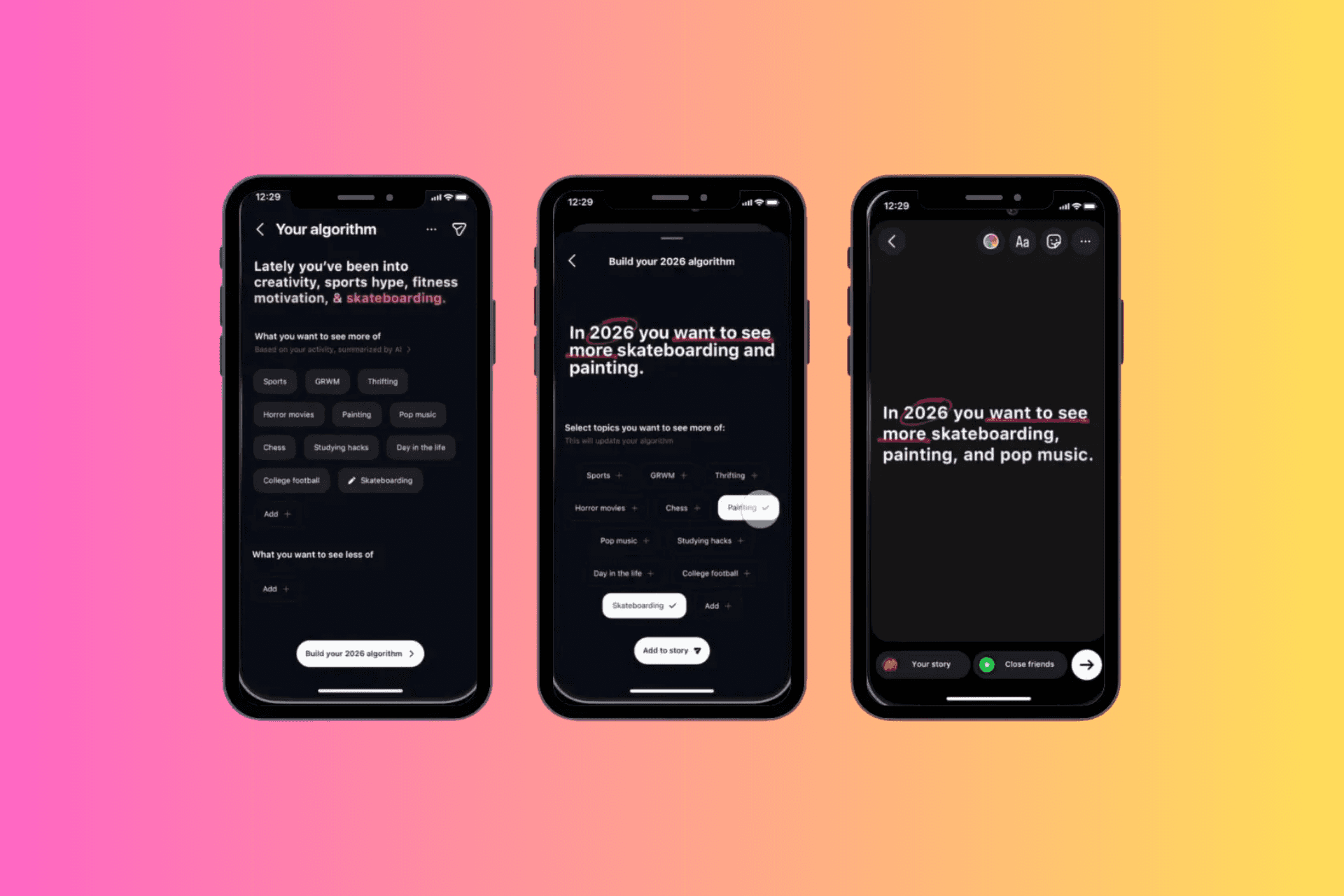
Instagram’s new “Your Algorithm” feature allows users to directly influence the content they are shown by selecting and removing interesting topics inside the app. (Tech Times)
Instead of relying solely on passive signals like likes, watch time, or shares, Instagram now combines them with explicit user input.
In simple terms
The platform no longer guesses what you want. It asks you.
Users are shown a dashboard of topics based on their behaviour, and can
Add interests they want more of
Remove topics they want less of
Prioritise key categories for the year (Wolfson Marketing)
This turns Instagram from a reactive feed into a controlled recommendation engine.
When is it rolling out?
The rollout has happened in phases.
Initial testing began with select users in 2025 (Cariad Marketing)
Wider testing expanded through late 2025
Official rollout began in December 2025
By early 2026, it will be live across English-speaking users (Wolfson Marketing)
Global expansion beyond English-language accounts is expected, but timelines are not formally confirmed.
Why is Instagram doing this now?
There are three clear drivers behind this shift.
1. Transparency pressure
Users want to understand why they are seeing what they see. Algorithm opacity has become a trust issue.
2. Competition with TikTok
TikTok has conditioned users to expect highly relevant feeds. Instagram is responding with more control and clarity.
3. Better data signals
Explicit interest selection is far more accurate than inferred behaviour alone. (SEO Services Agency USA)
For Instagram, this is about precision, and for users, it feels like control.
What this means for people using Instagram
For everyday users, this changes the experience immediately.
Less randomness
Your feed aligns more with what you actively choose.
Faster content refinement
You can train your feed in minutes instead of weeks.
More intentional consumption
Discovery becomes something you shape, not just something that happens to you.
The passive scroll is becoming an active system.
What this means for creators and brands
This is where the impact becomes significant.
Relevance replaces reach
Content is no longer distributed broadly and filtered afterwards.
It is filtered before it is distributed.
If your content is unclear in topic, it will not match the user-selected interests.
Niche clarity becomes a growth driver.
Creators who sit clearly within defined topics will benefit.
Those who cover multiple vague themes will struggle.
As highlighted in recent algorithm analysis, Instagram is now matching content to defined interest categories rather than broad engagement patterns. (Wolfson Marketing)
Accidental virality reduces
“Random” reach becomes less likely. But qualified reach increases.
Smaller, more aligned audiences with higher intent will lead to stronger conversion.
Engagement quality matters more than ever.
Shares, saves and watch time remain dominant signals.
Likes are increasingly secondary (Two Stones -)
How users actually build their algorithm
The process is intentionally simple.
Inside Reels, users can access the “Your Algorithm” panel and
View current interest categories.
Select topics they want more of
Remove irrelevant content areas.
Adjust preferences over time.
Instagram combines this with behavioural signals such as
Watch time
Shares
Saves
Search behaviour
This creates a hybrid system. Declared interest plus observed behaviour.
How brands and creators should respond
This is not about gaming a system. It is about aligning with it.
1. Define clear content pillars
Two to four brand themes maximum
Everything should sit cleanly within one.
2. Make your content unmistakable
The first three seconds should signal.
Who it is for
What it is about
3. Build repeatable formats
Series outperform one-off posts.
They reinforce topic association.
4. Optimise for shareability
Content that gets sent in DMs is now one of the strongest distribution signals (iidb.com)
5. Think in audience alignment, not reach
The goal is not visibility.
It is relevancy
A shift we have seen before
This is not the first time platforms have moved towards user control.
We have seen it with
TikTok interest filters
YouTube recommendation feedback loops
Spotify personalised discovery
Instagram is now formalising what has been happening quietly. Users train their feeds through behaviour. Now they are doing it explicitly.
Conclusion
The Bigger Picture
In 2026, you do not optimise for Instagram, you optimise for alignment. The idea of “beating the algorithm” is becoming outdated, as the algorithm becomes a reflection of user intent. Clear, consistent, relevant content travels further, not via tricks, but because the system has better information. It means that the brands that win are no longer the loudest. They are the most clearly defined.