Written by
Abbie Mason
Why Experiential Marketing Hits Harder When Times Are Tough
There's a pattern that plays out every time economic uncertainty takes hold.
Introduction
Brands cut budgets. Campaigns get pulled.
The default becomes doing less, spending less, and waiting for conditions to improve before committing to anything bold.It's understandable. It's also, for most brands, exactly the wrong move.
While most pull back, the brands that lean in, specifically into experiential marketing, tend to emerge from downturns with something far more valuable than short-term savings. They come out with customers who remember them. And in a market where everyone is competing for the same cautious, selective, increasingly hard-to-reach consumer, that memory is everything.
Cautious Consumers Need to Feel Something Before They Buy
When money feels tight, how people spend it changes, but not in the way brands often assume.
The instinct is to think that cautious consumers want to be reached with deals, discounts, and rational arguments. Lower the price, make the offer undeniable, and they'll convert. There's some truth in that, but it misses the deeper shift happening in consumer psychology.
Research from Euromonitor found that 58% of consumers report moderate to extreme daily stress. As All Things Insights notes in their breakdown of what's next for consumers in 2026, uncertainty isn't just affecting wallets, it's affecting the emotional relationship people have with the brands they choose. At the same time, Escalent's consumer research shows that while over 60% of consumers still prioritise value in purchasing decisions, more than 40% are willing to pay more for products and brands aligned with their values.
That tension, cautious with money, but not purely rational about it, defines the current consumer. What it tells us is that the path to a purchase in an uncertain climate isn't just a cheaper price. It's a stronger emotional reason to choose you.
This is where experiential marketing earns its place. An experience doesn't ask someone to be convinced. It invites them to feel something. And feeling something trust, warmth, excitement, belonging, is a far more durable driver of purchase behaviour than seeing an ad, however well-targeted it might be.
Economic uncertainty doesn't reduce the need for emotional connection. It increases it. The brands that understand this aren't cutting their way to relevance. They're building it.
The ROI Argument: Shareability Does the Heavy Lifting
The most common reason brands hesitate on experiential marketing is cost. A campaign, a pop-up, a sponsored event, these feel expensive compared to a social media ad buy with clear CPM metrics attached.
The comparison misses what experiential actually produces.
When a well-executed brand experience reaches fifty people in a room, those fifty people don't stay in the room. They post. They tell people. They share moments that feel genuine because they are, nobody performs enthusiasm about an Instagram ad, but they absolutely perform enthusiasm about an experience that genuinely moved them. The organic reach generated by a single activation can far exceed what a paid campaign of equivalent cost would deliver.
Research backs this up. Studies on experiential marketing consistently show that 85% of consumers are more likely to purchase from a brand after attending a live experience, and 70% become repeat customers. Average event ROI sits between 25 and 34%, with high-performing activations reaching multiples of that.
The key insight isn't that experiential is cheap. It's that it's efficient in ways traditional formats aren't. You're not renting attention from an algorithm for a few seconds. You're creating a memory that the consumer carries with them and, crucially, shares with their network, often in a way that feels far more credible than anything the brand could say about itself.
During a period when every budget line is under scrutiny, the question isn't whether you can afford experiential marketing. It's whether you can afford to keep investing in formats that people scroll past.
The Brands That Showed Up Are the Ones People Remember
The evidence for experimentation during difficult periods isn't theoretical. It's sitting in the brand equity of the companies that chose to show up when others didn't.
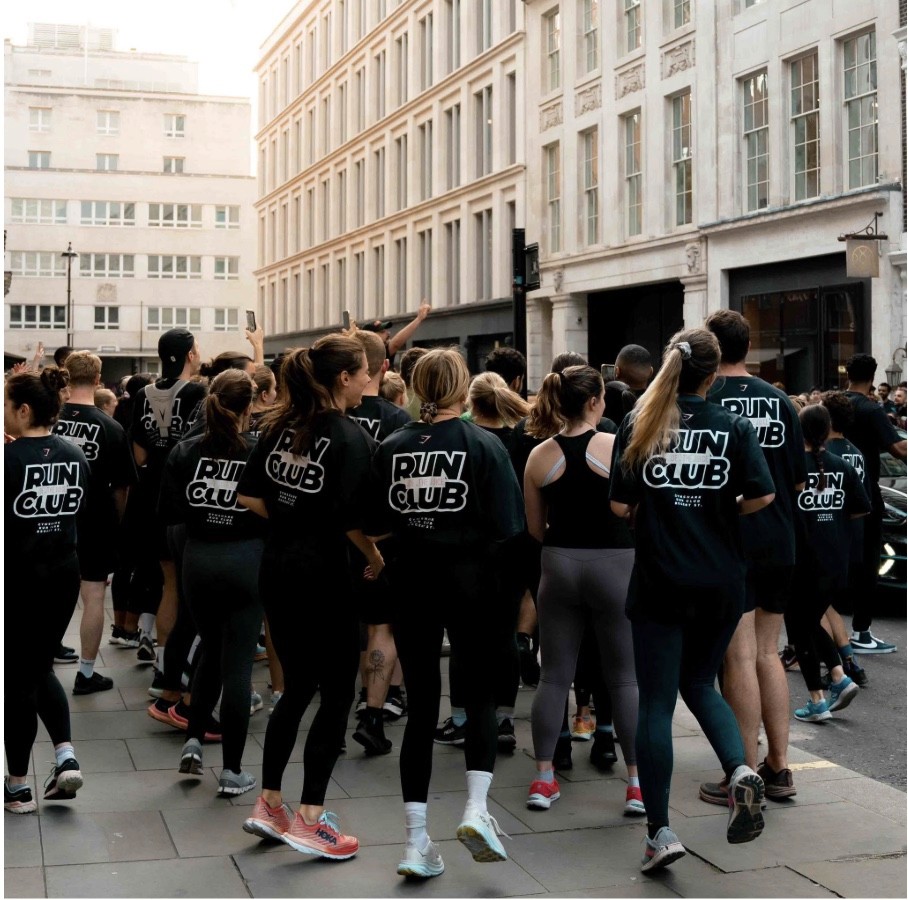
Gymshark built one of the most loyal communities in fitness before it had a single permanent retail location. From early pop-up events and expos to the Gymshark Run Club, regular, free, community-led running sessions that bring people together under the brand, these weren't polished activations with a hard sell attached. They were spaces where the brand and its audience met each other in the same physical space. The loyalty that came from those moments isn't the kind you can buy with a Google ad. It's the kind you earn by showing up and making people feel like they belong somewhere. That foundation has made Gymshark resilient in markets where many competitors haven't survived.
Innocent Drinks has spent years investing in the kind of marketing that doesn't look like marketing. Community events, neighbourhood activations, the sort of brand presence that feels less like a campaign and more like a personality showing up in the world. At a time when most FMCG brands were fighting for shelf space through promotions, Innocent was building affection. The ROI on that affection has compounded over decades.
Airbnb took the logic further. Experiences became a core product line, not just a marketing strategy. As The Brand Strategy Lab highlights in their look at branding trends for 2026, consumer spending on experiences is outpacing spending on goods, and Airbnb's 491 million nights booked reflects exactly that shift. The brand didn't just understand the experience economy. It built a business inside it.
The throughline across all three is the same. Economic uncertainty increased the distance between consumers and brands that relied purely on advertising. Brands that created genuine moments, things people could feel and remember, closed that distance. And when conditions improved, the people who remembered them came back.
Conclusion
What This Means for Brands Right Now
Experiential marketing in 2026 doesn't have to mean a festival or a global pop-up tour. The principle scales down as well as up. A local event. A community partnership. A product sampling moment that gives someone a genuine experience of what you do before they spend anything. These are all versions of the same idea: giving consumers a reason to feel something about your brand, not just see it. The brands that will be remembered when the current period of uncertainty lifts aren't necessarily the ones that spent the most. They're the ones that created genuine moments, that made people feel something at a time when most brands went quiet. Seeing something gets forgotten. Feeling something doesn't.